
DRIVE-IN RACKING
Achieve up to 85% space utilisation with drive-in pallet racking. The ultimate high-density storage solution for bulk quantities and cold-store environments. Supplied and installed UK-wide.
Space Utilisation
Pallets Deep
Stock Rotation
Cold-Store Rated
What Is Drive-In Racking?
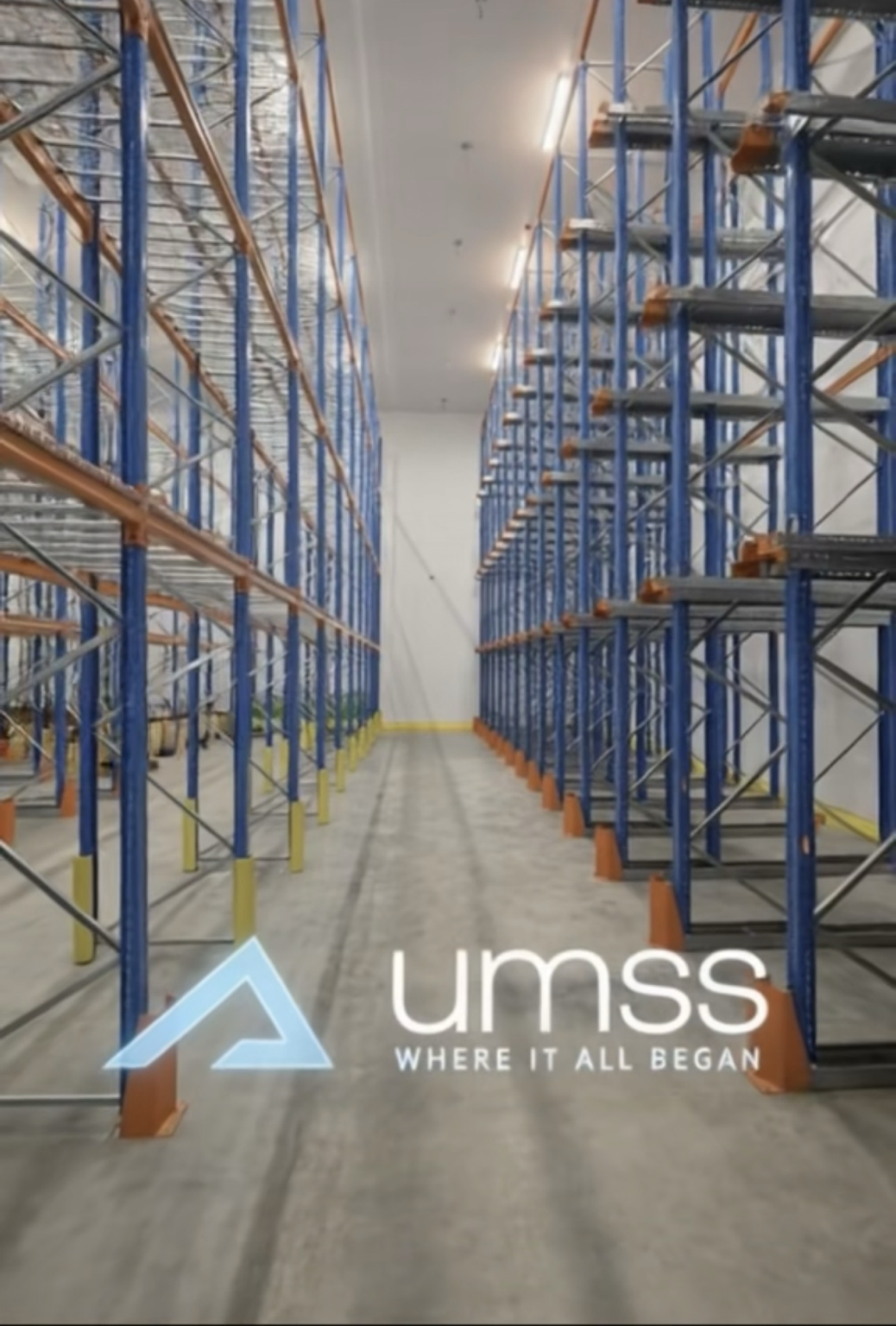
Drive-in racking is a high-density storage system where forklifts drive directly into the racking structure to place and retrieve pallets on rails. By eliminating the need for aisles between every row, drive-in systems can achieve up to 85% floor space utilisation — compared to around 50% with conventional selective racking.
This makes drive-in racking the preferred choice for warehouses storing large volumes of identical products, seasonal stock, or goods in cold-store and freezer environments where maximising cubic capacity directly reduces energy costs.
Drive-In vs Drive-Through
Drive-In (LIFO)
Single entry point. Last pallet in is the first out. Best for non-perishable bulk goods where date rotation is not critical.
Drive-Through (FIFO)
Entry from both ends. First pallet in is the first out. Ideal for perishable goods, pharmaceuticals, and date-sensitive stock.
Ideal Applications
FREQUENTLY ASKED QUESTIONS
What is drive-in racking?
Drive-in racking allows forklifts to drive directly into the racking structure to load and retrieve pallets. It eliminates aisles between rows, providing extremely high storage density — ideal for bulk storage of identical products.
What is the difference between drive-in and drive-through racking?
Drive-in racking has one entry point (LIFO — Last In, First Out). Drive-through racking has entry points at both ends (FIFO — First In, First Out), making it better for perishable or date-sensitive goods.
How deep can drive-in racking go?
Drive-in systems typically run 6–10 pallets deep, though deeper configurations are possible. The optimal depth depends on your product range and stock rotation requirements.
Is drive-in racking suitable for cold stores?
Absolutely. Drive-in racking is one of the most popular systems for cold-store and freezer environments because it maximises storage density, reducing the volume of expensive refrigerated space required.
Drive-in racking stores pallets on continuous support rails inside a block of frames, so a counterbalance or reach truck enters the lane itself instead of travelling an aisle. On a typical 2,000 m² UK unit we replace roughly 1,100 selective pallet positions with 1,700–1,900 drive-in positions — the same building, around 65% more stock, and no structural work.
How We Engineer a Drive-In Lane
Every drive-in block we install starts with the pallet, not the rack. We measure your actual loaded pallet — most UK sites run a 1200 x 1000 mm CHEP or a 1200 x 800 mm Euro pallet — then set the rail centres to give 75–100 mm clearance each side of the pallet edge and 150 mm above the load. Get that clearance wrong by 25 mm and a driver clips a frame every week, which is how most damaged drive-in blocks we are called out to repair began life.
Lane entries take the punishment, so we specify heavy-duty entry guides bolted to the floor slab and reinforced first uprights on every lane mouth. Where a site runs older counterbalance trucks with poor visibility we add 100 x 100 mm galvanised corner protection as standard. It costs a fraction of a frame replacement and keeps a SEMA inspection green.
Rail brackets are fixed at 1,000–1,200 mm vertical pitch depending on pallet height, and we always design the top beam level so the highest pallet top sits at least 500 mm below sprinkler deflectors — a requirement your insurer will check before they renew.
- Lane depths of 2 to 12 pallets, 6–8 deep is the UK sweet spot
- Rail load capacities from 1,000 kg to 1,500 kg per pallet
- Frame heights to 12,000 mm for high-bay and cold-store units
- Galvanised finish for chilled and freezer environments
- Entry guides and floor-fixed deflectors on every lane
- Designed to FEM 10.2.02 and installed to SEMA guidance
When Drive-In Beats Selective Racking — And When It Doesn't
The honest rule we give customers on survey: drive-in works when you hold at least five to six pallets of every SKU. Below that, lanes sit part-empty, your real utilisation collapses to around 70% of the theoretical figure, and you would have been better off with adjustable pallet racking and a narrower aisle.
Cold stores are the clearest win. At −25 °C, running cost per cubic metre is high enough that halving the aisle count typically pays for the entire racking system inside three to four years on energy alone. That is why almost every frozen food store we work on in the Midlands uses drive-in or drive-through rather than selective.
Where date rotation matters, we specify drive-through — open at both ends for FIFO — and accept the loss of one block face. For mixed operations we routinely design hybrid layouts: a drive-in block against the back wall for bulk lines and two selective runs at the pick face, so order pickers never enter a lane.
Safety, Inspection and Load Notices
Drive-in racking absorbs more impact than any other system because the truck is inside the structure. SEMA and HSE guidance HSG76 require a documented rack inspection at least every 12 months by a technically competent person, plus weekly visual checks recorded by your own PRRS. Our SEMA-approved inspectors grade damage green, amber and red, and we carry replacement uprights and rails for the main UK brands so an amber can be closed out in days rather than months.
Every block we hand over carries a load notice showing maximum pallet weight, lane depth, and the number of pallets permitted per rail level. If your existing drive-in has no legible load notice, it fails inspection — we can re-calculate and re-issue one after a site survey.
Technical Specifications
- Space utilisation
- Up to 85% of floor areaCompared with 45–50% for selective pallet racking at 2.8 m aisles.
- Typical lane depth
- 6 to 10 palletsDeeper lanes are possible but increase honeycombing losses.
- Pallet capacity per rail position
- 1,000–1,500 kgConfirmed against your heaviest pallet, not the average.
- Operating temperature
- Down to −30 °CHot-dip galvanised components for freezer and chilled stores.
- Standards
- FEM 10.2.02, SEMA codes, HSG76Annual expert inspection and weekly recorded visual checks.
- Lead time
- Typically 2–4 weeksUsed and refurbished stock can often ship inside 7 days.
EXPLORE UM STORAGE SYSTEMS
Browse our full range of warehouse storage solutions, products, and expert resources.
Our Services
Products & Equipment
Guides & Resources
Storage Solutions
READY TO OPTIMISE YOUR WAREHOUSE?
Get in touch today for a free, no-obligation consultation. Our team will assess your requirements and provide a tailored solution.