CANTILEVER RACKING
Purpose-built storage for timber, steel, pipes, furniture, and other long or awkward items. Single and double-sided systems with indoor and outdoor options. Supplied and installed across the UK.
What Is Cantilever Racking?
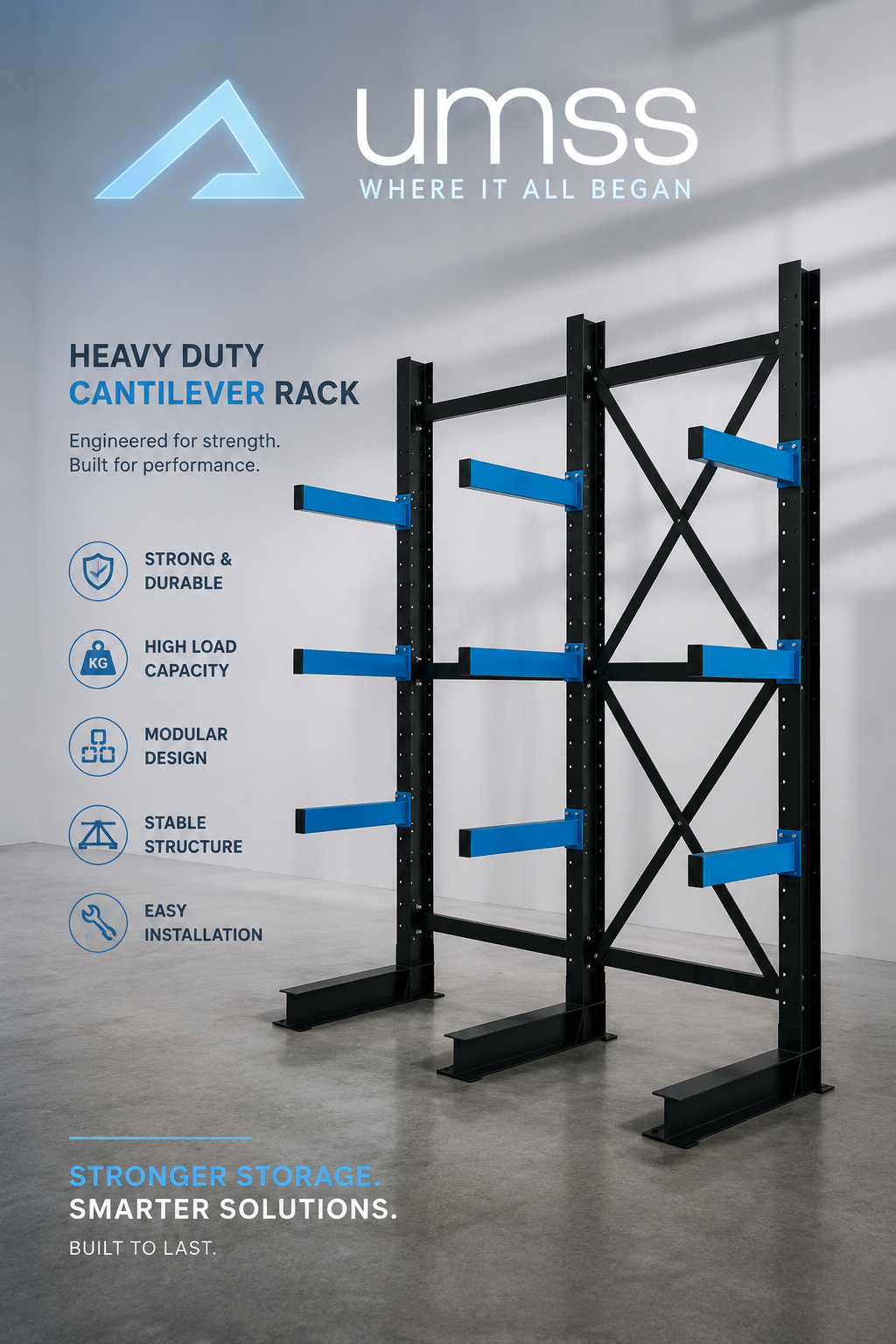
Cantilever racking uses a column-and-arm design with no front uprights, creating an unobstructed open face for easy loading and unloading of long, heavy, or irregular items. Arms extend from central columns and can be adjusted in height to accommodate different product sizes. This makes cantilever the ideal solution for timber yards, steel stockholders, furniture warehouses, plumbing suppliers, and building merchants.
Configurations
Single-Sided
Positioned against walls or building perimeters. Arms extend from one side of the columns only. Ideal for maximising wall space in warehouses and workshops.
- Wall-mounted option available
- Arms from 600mm to 1,500mm
- Up to 1,500kg per arm
Double-Sided
Freestanding with arms extending from both sides. Ideal for central warehouse positions, timber yards, and outdoor storage areas where access from both sides is required.
- Freestanding design
- Access from both sides
- Up to 2,000kg per arm
Typical Applications
FREQUENTLY ASKED QUESTIONS
What is cantilever racking used for?
Cantilever racking stores long, heavy, or awkward-shaped items that don't fit on standard pallets — timber, steel bars, pipes, plasterboard, furniture, carpets, and similar products. The open-front design allows easy loading with forklifts or overhead cranes.
How much weight can cantilever racking support?
Arm capacities range from 500kg to 2,000kg+ per arm depending on the configuration. Total column capacities can reach 10,000kg+. We engineer every system to your specific load requirements.
Can cantilever racking be used outdoors?
Yes. We supply galvanised cantilever racking for external applications including timber yards, builders' merchants, and steel stockholders. The galvanised finish provides long-term corrosion protection.
Do you install cantilever racking?
Yes. Our CSCS-qualified teams install cantilever racking systems across the UK. We handle everything from initial design and CAD layout through to professional installation and certification.
Cantilever racking stores long, awkward loads — timber, steel tube, plasterboard, PVC-u profile, carpet rolls — on arms projecting from a single column, so there are no front uprights to obstruct a side-loader or crane. A standard heavy-duty UK column takes 4,000–6,000 kg total per side, with arms rated from 500 kg to 1,500 kg each depending on arm length.
Specifying Columns, Arms and Bases Correctly
Cantilever design starts from the arm, because arm capacity falls as arm length rises. A 1,000 mm arm that carries 1,000 kg will typically carry around 600 kg at 1,500 mm — the bending moment at the column connection is what governs. We size arms to your longest and heaviest item, not the average, and always allow a minimum of two arms under every load with a rule of thumb of one arm per 1,200 mm of load length for flexible material like plasterboard or timber sheet.
Bases carry the overturning moment. For single-sided runs against a wall we specify longer bases and floor anchors at every base; double-sided runs balance each other and need shorter bases, which is why double-sided is nearly always cheaper per tonne stored. Arms are usually pitched at 100 mm increments up the column so levels can be changed as your stock profile changes.
Finish matters outdoors. Around a third of the cantilever we install in the Midlands sits in an external yard for steel, timber or building supplies, so we specify hot-dip galvanised columns, arms and bracing rather than powder coat, and design for wind loading where the run is over 5 m tall or carries sheet material that acts as a sail.
- Light, medium and heavy duty columns from 2,000 mm to 6,000 mm tall
- Arm lengths from 400 mm to 2,000 mm, straight or inclined
- Arm capacities from 500 kg to 1,500 kg per arm
- Single-sided for walls, double-sided for open floor and yards
- Hot-dip galvanised finish for external timber and steel yards
- Timber, mesh or steel decking to convert bays into bulk shelving
Sector Applications We Install Most Often
Builders' merchants and timber yards are the largest single group. A typical branch run is double-sided, 4,000 mm high, 1,000 mm arms at four levels, with inclined arms on the top level so lengths cannot roll off. Steel stockholders go the other way — shorter columns, heavier arms, closer column centres because steel tube concentrates weight in a short span.
Carpet and flooring distributors need a hybrid: cantilever for rolled goods stored horizontally, plus vertical roll racking or textile cradles for shorter rolls. Plastics and PVC-u fabricators usually want fully decked cantilever bays so profile bundles cannot sag between arms.
For anyone handling long loads with a side-loader, column centres and aisle width matter as much as the racking. Side-loaders need around 3,500–4,500 mm of aisle depending on load length; a four-way combi truck can work considerably tighter. We design the aisle around your truck, and if you do not yet have one we will tell you which route gives the lowest total cost.
Safety, Load Notices and Inspection
Cantilever fails differently from pallet racking: overload usually shows as arm deflection or base lift rather than a buckled upright. Any arm with visible permanent droop, or a base plate where the anchor has pulled and left a gap under the plate, is a red risk and should be offloaded immediately. We see both regularly on racking that was installed without a load notice, so nobody on site knew what the arms were rated for.
Under HSG76 and SEMA guidance, cantilever runs need the same regime as any other racking: weekly recorded visual checks by a nominated Person Responsible for Racking Safety, and an annual inspection by a SEMA-approved inspector. We supply a laminated load notice per run showing arm capacity, capacity per column side and maximum load length, and we hold replacement arms, columns and bracing for the main UK systems.
Technical Specifications
- Capacity per column side
- Up to 6,000 kgTotal across all arms; heavy-duty columns available above this on request.
- Arm capacity
- 500–1,500 kg per armReduces as arm length increases — sized to your longest load.
- Arm lengths
- 400 mm to 2,000 mmStraight arms for decked bays, inclined arms for rolling stock.
- Column heights
- 2,000 mm to 6,000 mmTaller external runs designed for wind loading.
- Arm pitch
- 100 mm incrementsLevels can be re-set as your product mix changes.
- Finish
- Powder coat or hot-dip galvanisedGalvanised specified as standard for external yards.
EXPLORE UM STORAGE SYSTEMS
Browse our full range of warehouse storage solutions, products, and expert resources.
Our Services
Products & Equipment
Guides & Resources
Storage Solutions
Local Cantilever Racking Installers
Based in Stourbridge and covering the West Midlands with fast local response for cantilever racking supply and installation.
READY TO OPTIMISE YOUR WAREHOUSE?
Get in touch today for a free, no-obligation consultation. Our team will assess your requirements and provide a tailored solution.